The Price of Distinction
Monetary units from past economies often have little meaning for modern readers. This website translates historical monetary amounts—income, expenses, and wealth—into a consistent and interpretable metric: an individual's position in the income or wealth ladder of the time.
Explaining the Income Ladder Approach
To capture the exclusivity of a monetary amount \(y\) in location \(\ell\) at time \(t\), we characterize income by the share of the population earning at most that amount:
where \(F(\cdot)\) denotes the cumulative income distribution in location \(\ell\) at time \(t\). For example, an income level \(\bar{y}\) corresponding to the top-1% of the population satisfies \(P\left(Y \leq \bar{y}\right)=0.99\).
However, the high exclusivity of many incomes and expenses reported in cultural production makes this representation difficult to interpret. We therefore apply a logarithmic transformation to the upper tail of the distribution:
This income ladder approach relies on recent advances in the measurement of inequality, as captured by estimates of the distribution function \(F\). By construction, it yields a unit-free and time-invariant measure of economic position that is directly comparable across periods and locations.
Income distributions are estimated by fitting a Burr distribution to match key moments of the income distribution as reported in the World Inequality Database.
Wealth distributions are estimated by fitting a generalized Pareto distribution.
The full approach is described in this working paper.
Finally, note that in the Examples and Exploration sections the x-axis uses a split scale: linear up to a threshold, then compressed logarithmically for the upper tail.
Examples
A good marriage? 10,000 pounds in 1813
In unequal societies, where returns to capital dwarf those to labor, marriage can be one of the few paths to upward mobility. Pride and Prejudice vividly illustrates these incentives. Elizabeth faces two possible matches: Mr. Collins at £700/year and Mr. Darcy at £10,000/year. What did these sums represent? The chart places both incomes within the English distribution around 1810. Mr. Darcy ranks in the top 0.005 percent—among the wealthiest 350 adults out of 6.4 million. Mr. Collins, by contrast, would “only” lift Elizabeth into the top 0.3 percent, among the richest 19,200 adults: comfortable, but far from Darcy’s rarefied world.
Notes: The red line traces the income ladder: for each income level (x-axis), it shows the share of the population earning more than that amount, capturing its exclusivity. The shaded green area represents the overall income distribution of England's adult population in 1810.

Pride and Prejudice, an 1833 engraving from Chapter 59
Converter
Input an amount, location, and date, and receive the corresponding (top) percentile and population rank.
Historical examples
Batch Conversion
One row per observation: year, country, amount, type, frequency
— type: income / expense / wealth frequency: annual / monthly / weekly / daily (default: annual).
Exploration
Select periods, countries, or novels, and compare the income distributions of protagonists and other characters with the actual income distribution.
Narratives
Explore social structure and wealth inequality in classic literature through the income ladder framework.
During the industrialization of the nineteenth century, new forms of inequality emerged, gradually replacing the aristocratic order of the eighteenth century and profoundly reshaping French society and literature. This transformation lies at the heart of the Realist movement associated with Honoré de Balzac. His Comédie humaine portrays French society between 1815 and 1848 through a vast collection of interconnected novels. Le Père Goriot is among the most emblematic of these works, contrasting the ambitious rise of Rastignac with the gradual downfall of Père Goriot.
While the novel vividly illustrates the gulf in wealth separating the highest echelons of society from the lowest, the magnitude of these differences may escape contemporary readers. Early in the narrative, we learn that Rastignac—the young protagonist—receives an annual income of 1,200 francs from his family. This amount is portrayed as insufficient by the ambitious Rastignac, who asks his family for an additional 1,200 francs, noting that "two nicely tailored pairs of trousers could win a marriage worth 20,000 francs a year." How large is an income of 1,200 francs in this context, and how much more exclusive is an income of 20,000 francs?
That said, Rastignac is not mistaken in lamenting his distance from the very top of society. The income distribution in France around 1830 is highly skewed, with a pronounced upper tail. Advancing further up the income ladder requires far more than a marginal increase: reaching the top 0.1 percent would require an annual income on the order of 20,000 francs.
This highly skewed income distribution is a central premise of the Comédie humaine and of many other nineteenth-century novels, as our approach illustrates.
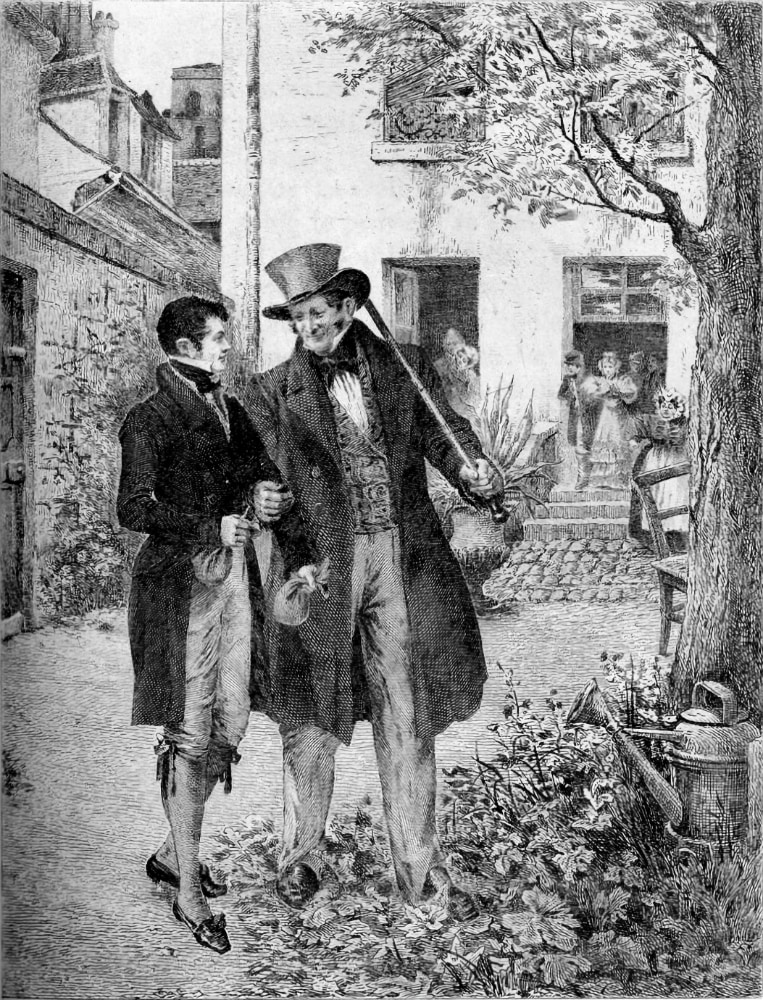
Eugene de Rastignac (left), in discussion with Vautrin (Le Père Goriot, 1830)
Unequal access to opportunity is also central to Pride and Prejudice, where inequality manifests in another defining feature of such societies: the primacy of capital over labor. Elizabeth Bennet's precarious financial outlook sets the stage for the novel. Upon her father's death, her income would fall to approximately £40 per year. While this amount would still place her in the top 10 percent of the income distribution in England, it would leave her far removed from the upper classes.
In such unequal societies, one of the few avenues for upward mobility is marriage. Elizabeth considers—and rejects—several suitors. Reaching the top 0.1 percent in England would require an annual income of roughly £1,500: a position below that of her father, Mr. Bennet, but above that of the rejected Mr. Collins.
The nineteenth century witnessed the rise of a more realist literature in France, driven by the work of Balzac, as well as Alexandre Dumas and Eugène Sue, often serialized in newspapers. A similar movement emerged in painting, notably in the work of Gustave Courbet and Jean-François Millet (see below).
The premise of Les Misérables rests on the arrest of Jean Valjean for stealing a loaf of bread—the most basic consumption good. In the context of the economic conditions surrounding the French Revolution of 1830 and the associated high inflation, such a loaf could cost 12-13 sous (around 0.60 francs), making it unaffordable for many poor workers (A New Look at the French Revolution of 1830, David H. Pinkney, The Review of Politics, 1961, 23-4). Another important episode in the novel is Valjean's rescue of Cosette, for which he pays the Thénardiers 1,500 francs.
The sum of 1,500 francs is used by Victor Hugo to illustrate the greed of Monsieur (and Madame!) Thénardier. The context is similar to that of Rastignac at the start of Le Père Goriot: the median income in France around 1830 was approximately 250 francs, and 1,500 francs corresponds to an annual income earned by less than 5 percent of the population. This is a substantial amount. Yet:
"When the man and Cosette had taken their departure, Thénardier allowed a full quarter of an hour to elapse; then he took her aside and showed her the fifteen hundred francs. "Is that all?" said she.""
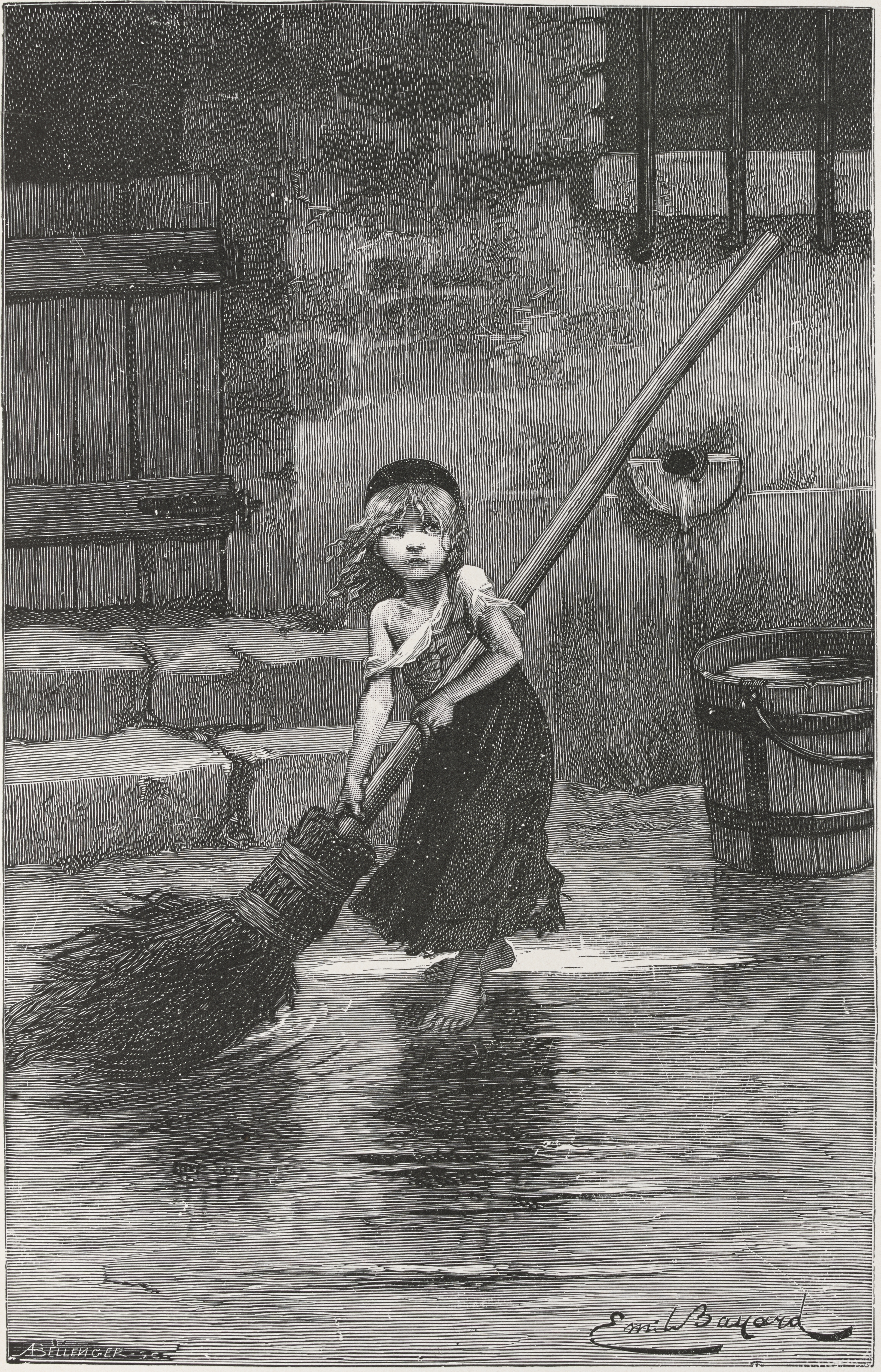
Cosette (Les Misérables, 1862)
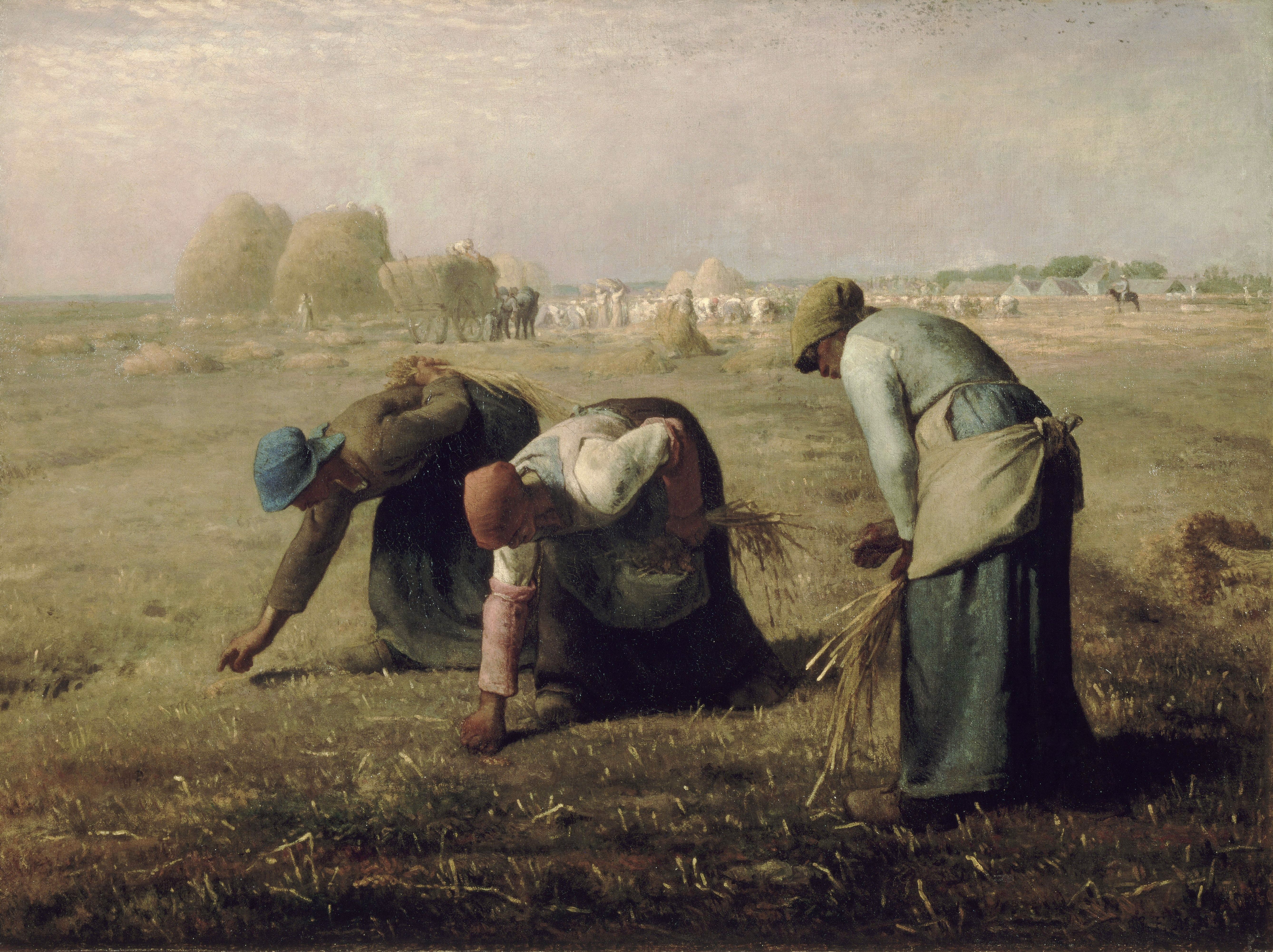
Des glaneuses (Jean-François Millet, 1857)
About
Research
This website builds on research by Regis Barnichon (San Francisco Fed) and Yanos Zylberberg (University of Bristol).
Contributors
The development of the website also benefited from the contributions of Katie Bartlett, Jacob Colbeck, and Faith Woodruffe-Peacock, students at the University of Bristol.